La rivista e il marketplace globale per gli appassionati di auto d’epoca, creati da appassionati.
La rivista e il marketplace globale per gli appassionati di auto d’epoca, creati da appassionati.


Faccia la sua scelta
- Automobile
-
Marca >>
-
Anno >>
-
- Motociclette
-
Anno >>
-
-
Ubicazione >>
- Parti e altro
-
Marca dell'auto >>
-
Produttore >>
-
Categoria >>
-
Paesi


Il mercato; tutte le auto prebelliche in vendita
Panoramica degli annunci correlati all'annuncio 1948 Jaguar Mk IV 3½ litre
-

1948 MG TC
Original,solid car which was in long term ownership prior to be given to Owls transport museum to display,so the car has no rust or rot in body or frame due to being kept indoors and looked after.Imported by myself and all taxes paid with nova documents ready for its first uk owner to be on the V5.The paintwork seems original ,the soft ..1948MGTCVENDUTOUbicazione: Regno Unito -
1956 Jaguar XK140 MC Roadster
1956 Jaguar XK140 MC RoadsterWhen Jaguar unleased the XK120 on the world in 1949, it raised the bar for performance and style at an astonishingly affordable price point. The follow-up to the 120 came in 1954, which Jaguar dubbed the XK140, offering a wealth of improvements to address the shortcomings of the earlier model. With the ..1956JaguarXK140 MCVENDUTOUbicazione: Stati Uniti -
1963 Jaguar SS100 by Suffolk Engineering | Historics Auctioneers
The SS100 was built between 1936 and 1940 by SS Cars Ltd of Coventry, England. The nomenclature was to reflect the theoretical 100mph maximum speed and once approved by Sir William Lyons, the name 'Jaguar' was given to a new saloon version in 1936. Widely considered to be one of the most aesthetically pleasing Jaguar cars ever built, it is also one..1963JaguarSS100 by Suffolk EngineeringVENDUTO -
1963 Jaguar E-Type Series I Roadster (3.8 litre) | Historics Auctioneers
Introduced in 1961, the Jaguar E-Type caused a sensation when it appeared with its instantly classic lines and 150mph top speed. While, inevitably, the car's stupendous straight-line performance and gorgeous looks grabbed the headlines, there was a lot more to the E-Type beneath the skin. The newcomer's design owed much to that of the racing D-Type..1963JaguarE-Type Series I Roadster (3.8 litre)VENDUTO -
1988 Jaguar XJRS Le Mans Coupé | Historics Auctioneers
The Jaguar XJS design, codenamed XJ27, started around 1965 with the first production car being sold in 1975. It was primarily designed by Malcolm Sayer with input and control from Sir William Lyons. Although the public assumed the Jaguar XJS was a successor to the very popular E-Type it was in fact intended to be very different. It would be comfort..1988JaguarXJRS Le Mans CoupéVENDUTO -
1997 Jaguar XK8 Coupé | Historics Auctioneers
Jaguar cars today are designed in Jaguar Land Rover's engineering centres at the Whitley plant in Coventry and at their Gaydon site in Warwickshire with manufacturing at the Castle Bromwich assembly plant in Birmingham. The Jaguar XK series was introduced at the Geneva Motor Show on 5th March 1996 with the first generation of the series, the XK8, w..1997JaguarXK8 CoupéVENDUTO -
1967 Jaguar Mk. II (3.8 Litre) Saloon | Historics Auctioneers
Launched in 1959, the Jaguar Mk. II offered a noticeably improved driving experience over its predecessor courtesy of revised front suspension geometry, widened rear suspension and four-wheel disc brakes. Improvements were achieved by increasing the cabin glass area by almost 20%, while narrower front and central body pillars gave the car a more re..1967JaguarMk. II (3.8 Litre) SaloonVENDUTO -
1959 Jaguar Mk. II (3.4 M/OD) | Historics Auctioneers
Synonymous with the swinging `60s and the hit TV Series Inspector Morse, the Mk. II was undoubtedly the most admired saloon to emanate from Jaguar's hallowed Browns Lane factory. These cars punched well above their weight. Equipped with either a 3.4 litre or 3.8 engine, the Jaguar was capable of sprinting to 60mph in as little as 8.5 seconds and on..1959JaguarMk. II 3.4 MODVENDUTO -
1996 Jaguar XJS Celebration Coupé | Historics Auctioneers
The Jaguar XJS is a luxury grand tourer produced from 1975 to 1996 and replaced the E-Type. Although it never had quite the same sporting image, the XJS was a competent replacement with better aerodynamics than the E-Type and was last produced on 4th April 1996, by which time 115,413 had been produced during a 21 year production life. The car was r..1996JaguarXJS Celebration CoupéVENDUTO -
1969 Jaguar 420 G *WITHDRAWN* | Historics Auctioneers
DUE TO CIRCUMSTANCES BEYOND OUR CONTROL, THIS LOT HAS BEEN WITHDRAWN FROM THE AUCTIONThe Jaguar Mk. X, later renamed the Jaguar 420G was the top of the range saloon built by the British manufacturer primarily aimed at the US market. The unitary construction body-shell was codenamed ‘Zenith’ during development and this floor pan continued in product..1969Jaguar420 GVENDUTO





In primo piano
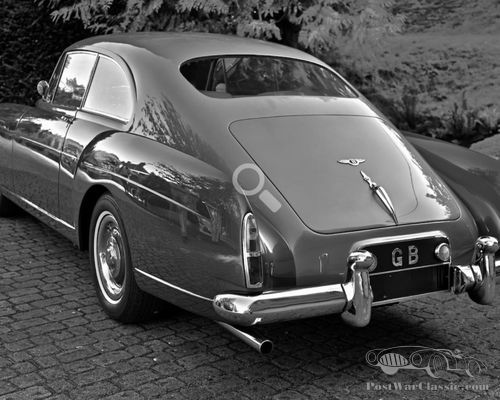
1957 Bentley S1 Fastback by H.J. Mulliner.
1957 Bentley S1 Fastback by H.J. Mulliner.A freshly restored award winning car in like new condition. A later car with Power assited steerin..
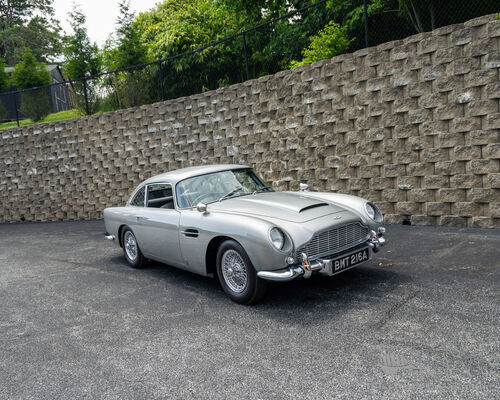
2020 Aston Martin DB5 Goldfinger Continuation | RM Sotheby's | The Monterey Auction
To Be OFFERED AT AUCTION at RM Sothebys' The Monterey Auction event, 13 - 15 August 2026. $1,000,000 - $1,500,000 USD One of 25 examples co..