La rivista e il marketplace globale per gli appassionati di auto d’epoca, creati da appassionati.


Il mercato; tutte le auto prebelliche in vendita
Panoramica degli annunci correlati all'annuncio Triumph Spitfire 1500
-

1979 Ford Bronco Ranger XLT | Amelia Island Auctions | Gooding & Co | March 2-3, 2023
First sold to the public in August 1965, Ford’s Bronco was one of the earliest examples of a sport utility vehicle and became an American icon. Designed to better compete in a growing utility market, the second generation was unveiled in 1978 as a larger truck with improved on-road manners. Based on a shortened version of the F-100 4x4 pickup, t.. -
1974 Porsche 911 Carrera 2.7 | Amelia Island Auctions | Gooding & Co | March 2-3, 2023
For the 1974 model year, Porsche’s flagship 911 received significant updates to comply with new safety and emissions rules in the US. The new G series featured a shorter hood, impact-absorbing bumpers, a rear reflective panel with Porsche lettering, and three-point safety belts. A new Carrera model was also introduced and offered to American buy.. -
1974 Lancia Stratos HF Stradale | Amelia Island Auctions | Gooding & Co | March 2-3, 2023
The story of Lancia’s most memorable postwar sports car begins at the 1970 Torino Motor Show, where Carrozzeria Bertone unveiled the dramatic new Stratos Zero concept. With its bold wedge shape, futuristic front-hinged door, and mid-mounted Fulvia powerplant, Bertone’s prototype was the star of the show and attracted the interest of Lancia direc.. -
1977 Porsche 934/5 | Amelia Island Auctions | Gooding & Co | March 2-3, 2023
Launched in 1976, the 934 was built by Porsche to compete in the FIA’s Group 4 GT class, replacing the venerable Carrera RSR 3.0. While the new model was based on the production 930 Turbo, very little – aside from the road car’s body shell and engine case – remained unchanged in the transformation to race-ready 934. FIA regulations requ.. -
1979 Pontiac Firebird Trans Am | Amelia Island Auctions | Gooding & Co | March 2-3, 2023
1979 saw a major transformation for Pontiac’s beloved Firebird, featuring a completely restyled body with improved aerodynamics, larger fender flares, and an enhanced rear spoiler. It also marked the end of the line for big-block V-8s from Pontiac with the optional 400 cid W72 V-8 engine. Claimed by Pontiac to produce 220 hp and 320 lbs./ft. of .. -
1973 Porsche 911 Carrera RS 2.7 Touring | Amelia Island Auctions | Gooding & Co | March 2-3, 2023
First developed to homologate the 911 for Group 4 racing, the Carrera RS 2.7 marked many firsts for Porsche. Launched in 1972, customers could choose from Touring and Lightweight models, both of which offered significant performance and weight savings over the standard 911S. Weight savings came by way of lighter-gauge sheet metal, thinner window.. -
1971 Mercedes-Benz 280 SE 3.5 Coupe | Amelia Island Auctions | Gooding & Co | March 2-3, 2023
Created in the Mercedes-Benz tradition of quality, engineering, and luxury, the W111 generation reached its pinnacle with the 280 SE 3.5. It introduced V-8 power to a Mercedes-Benz Coupe for the first time, adding heightened performance to the car’s virtues and furthering the heritage of the prestigious firm. This 3.5 Coupe was original.. -
1973 Ferrari 365 GTB/4 Daytona Spider | Amelia Island Auctions | Gooding & Co | March 2-3, 2023
Debuted in Paris in 1968, the 365 GTB/4 succeeded the 275 GTB/4 as Ferrari’s new top-of-the-line, two-seat gran turismo. Almost immediately, it was unofficially known as the “Daytona” in honor of Ferrari’s podium sweep at the 24 Hours of Daytona in 1967, and it stands as the last front-engine, V-12 GT model designed before Fiat’s takeov.. -
1973 Alfa Romeo 1600 Junior Zagato | Amelia Island Auctions | Gooding & Co | March 2-3, 2023
Designed by Zagato’s Ercole Spada and debuted at the 1969 Torino Motor Show, the Junior Zagato satisfied Alfa Romeo’s desire for a more sophisticated and upscale alternative to the Giulia GT coupe. Initially powered by a 1,300 cc engine, the 1,600 cc derivative was launched for the 1972 model year, allowing use of the entire Giulia Spider floor .. -
1970 Citroën Méhari | Amelia Island Auctions | Gooding & Co | March 2-3, 2023
Named after a swift dromedary camel, Citroën’s Méhari was an elemental and lightweight recreational and utility vehicle, based on the chassis and mechanicals of the 2CV. In fact, the Méhari was quite similar in concept to BMC’s Mini-derived Mini Moke. In addition to the innovative chassis and suspension design of the 2CV, the Méhari featured a u..



In primo piano
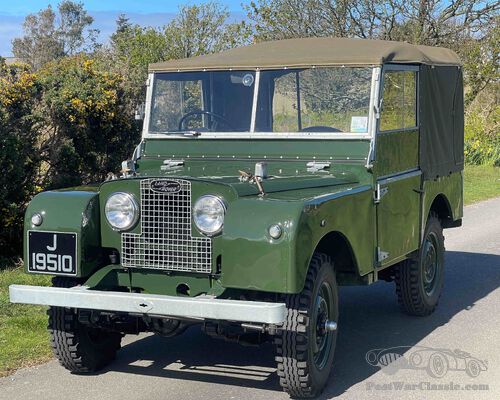
1952 Land Rover Series 1
Specifiche tecniche:Marca e modello: Land Rover Series !Anno: 1952Targa: immatricolata a Jersey..
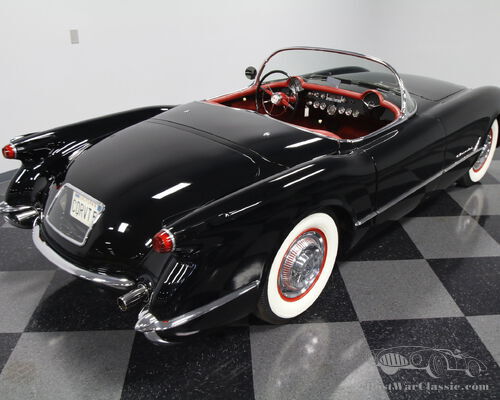
1954 Chevrolet Corvette C1
Fully restored 1954 C1 Corvette in Black. Stunningly beautiful car, feels like driving a sculptural work of Art. Known to be the oldest Corvette on t..
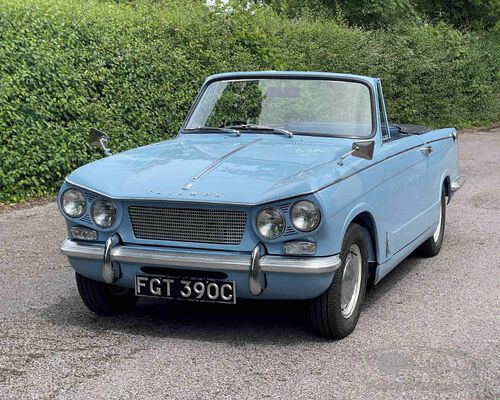
Triumph Vitesse 6 Convertible
Specifiche tecnicheMarca e modello: Triumph Vitesse 6 ConvertibleAnno: 1965Immatricolazione: Regno UnitoNumero d..