La rivista e il marketplace globale per gli appassionati di auto d’epoca, creati da appassionati.


Il mercato; tutte le auto prebelliche in vendita
Panoramica degli annunci correlati all'annuncio Citroën 2CV Type A – 1953
-

1952 Avions Voisin C31 Biscooter | Amelia Island Auction | Gooding & Company | March 1, 2024
Following WWII, Gabriel Voisin felt the market was ready for a small vehicle suitable for two passengers that could be driven without a license. With the chassis and bodywork made out of lightweight aluminum, the Biscooter was a low-cost, low-maintenance vehicle. With a basic hood and adjustable windscreen, the minimalist style reflected Voisin’.. -
1963 Citroën DS19 Concorde | Amelia Island Auction | Gooding & Company | March 1, 2024
In 1955, Citroën introduced the revolutionary DS19 sedan. Despite new coachbuilt cars being few and far between at that time, Henri Chapron made body modifications to a DS19 in 1958, without the endorsement of Citroën. Chapron’s name was synonymous with exquisite coachwork of French marques including Delahaye, Talbot-Lago, and Delage throughout .. -
1963 Citroën DS19 Le Dandy | Amelia Island Auction | Gooding & Company | March 1, 2024
Henri Chapron was a prominent Parisian coachbuilder of Art Deco-style automobiles in the 1930s. Following WWII, the need for such coachwork was diminishing. In 1958, with the introduction of the new Citroën DS, Chapron decided to create hand-built custom bodies without the support of Citroën. Chapron was initially required to purchase complete c.. -
1966 Citroën DS21 Le Leman | Amelia Island Auction | Gooding & Company | March 1, 2024
Following the revolutionary DS19 introduced at the Paris Motor Show in October 1955, Citroën created a successor to the model with the DS21. The 21 improved on the 19 with an increase in power from 75 to 125 hp. Both featured hydropneumatic suspension, allowing the vehicle to operate while balanced on three wheels if necessary. Until the 1950s, .. -
1958 Ferrari 250 GT Coupe | Amelia Island Auction | Gooding & Company | March 1, 2024
When Pinin Farina’s prototype for a 250 GT Coupe debuted at Geneva in March 1956, it was announced that this model would be produced by its designer and Mario Boano’s carrozzeria would manufacture a limited series of bespoke cabriolets. However, due to what many historians claim was an inadequate production capacity at Pinin Farina, Fer.. -
1957 Porsche 356 A 1500 GS/GT Carrera Speedster | Amelia Island Auction | Gooding & Company | March 1, 2024
In 1955, less than a year after the 356 Speedster model was introduced, Porsche built the first example equipped with the competition-derived four-cam Carrera engine. The result was a brilliant dual-purpose sports car, and the Carrera Speedster continued to be improved and refined over the course of production. For 1957, Porsche began t.. -
1955 Porsche 356 1500 Continental Coupe | Amelia Island Auction | Gooding & Company | March 1, 2024
Named at the suggestion of US importer Max Hoffman, the rare, one-year-only 356 Continental marks a fascinating moment during Porsche’s earliest years in the American marketplace. Unwittingly, Porsche’s marketing efforts attracted the attention of the mighty Ford Motor Company, which had already established the Continental Division as its flagsh.. -
1957 Alfa Romeo Giulietta Spider | Amelia Island Auction | Gooding & Company | March 1, 2024
In the mid-1950s, enthusiasts who were considering purchasing a small, open sports car found themselves presented with a compelling new choice: Alfa Romeo’s Giulietta Spider. It featured gorgeous Pinin Farina styling, twin overhead-cam alloy engine, outstanding ride quality, and weather protection equal to that of more expensive sports cars. Tod.. -
1954 Ferrari 500 Mondial Series I Spider | Amelia Island Auction | Gooding & Company | March 1, 2024
In December 1953, Ferrari unveiled its first four-cylinder production sports car – the 500 Mondial, named in honor of Alberto Ascari’s back-to-back World Championships. Like Ascari’s 500 F2 Monoposto, the Mondial featured a two-liter, twin-cam, four-cylinder engine designed by Aurelio Lampredi. Known internally as the tipo 110, this eng.. -
1974 Citroën SM | Amelia Island Auction | Gooding & Company | March 1, 2024
A fascinating combination of ingenious oleo-pneumatic, self-leveling suspension, elegant avant-garde styling by Robert Opron, and an exotic, quad-cam Maserati V-6, the Citroën SM remains among the most distinct and desirable GT cars of the past half century. The SM offered here is one of 134 examples originally built for the US market t..



In primo piano
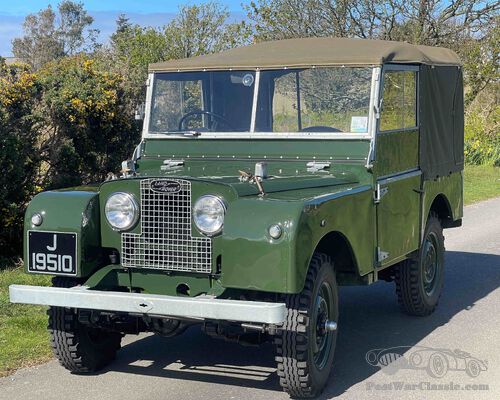
1952 Land Rover Series 1
Specifiche tecniche:Marca e modello: Land Rover Series !Anno: 1952Targa: immatricolata a Jersey..
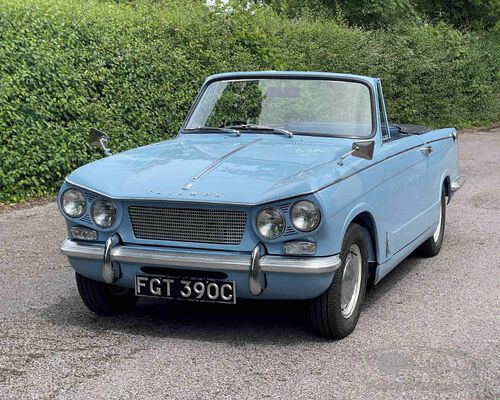
Triumph Vitesse 6 Convertible
Specifiche tecnicheMarca e modello: Triumph Vitesse 6 ConvertibleAnno: 1965Immatricolazione: Regno UnitoNumero d..
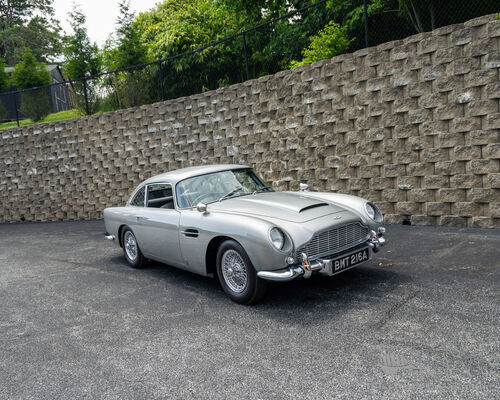
2020 Aston Martin DB5 Goldfinger Continuation
Offerta all'asta da RM Sotheby's durante The Monterey Auction, 13-15 agosto 2026. Stima: 1.000.000-1.500.000 USDUno dei s..