La rivista e il marketplace globale per gli appassionati di auto d’epoca, creati da appassionati.


Il mercato; tutte le auto prebelliche in vendita
Panoramica degli annunci correlati all'annuncio 1963 Fiat 850 ABARTH
-

1967 Porsche 911 SWB | Ascot Racecourse 2nd March 2024 Sale | Historics Auctioneers
The most historically significant of all Porsche models, so far, has been the 911, which was introduced in 1964 and, in much the same form, was to be the mainstay of Porsche production for more than 30 years, albeit constantly modified and uprated. With broadly similar layout to the 356, the 911 had a steel platform chassis with springing by torsio.. -
1969 Porsche 911 | Ascot Racecourse 2nd March 2024 Sale | Historics Auctioneers
The Porsche 911 is the flagship car of the German manufacturer. It has a distinctive design, rear-engined, with independent rear suspension, an evolution of the swing axle on the Porsche 356. Since its introduction in 1963, the 911 has undergone continuous development although the basic concept has remained little changed. Throughout its lifetime, .. -
1967 Mercedes-Benz 230 SL Pagoda | Ascot Racecourse 2nd March 2024 Sale | Historics Auctioneers
The Mercedes-Benz W113 roadsters, designed by Paul Bracq, were produced from 1963 through to 1971 with their distinctive 'Pagoda' hardtop roof giving them their contemporary nickname. All models feature an inline six-cylinder engine with multi-port fuel injection using a mechanical pump system adapted from the diesel engine. All are rear-wheel driv.. -
1964 Mercedes-Benz 230 SL Pagoda | Ascot Racecourse 2nd March 2024 Sale | Historics Auctioneers
The Mercedes-Benz W113 roadsters, designed by Paul Bracq, were produced from 1963 through to 1971 with their distinctive ‘pagoda’ hardtop roof giving them their contemporary nick name. All models feature an inline six-cylinder engine with multi-port fuel injection using a mechanical pump system adapted from the diesel engine. All are rear-wheel dri.. -
1969 Jensen Interceptor Mk. II | Ascot Racecourse 2nd March 2024 Sale | Historics Auctioneers
The Jensen Interceptor was launched in 1966 and the all steel bodyshell broke away from the company's traditional method of construction that used GRP (glass reinforced plastic). Designed by Carrozzeria Touring, the early cars were built by Vignale before production eventually was carried out at the Jensen works in West Bromwich. Power was delivere.. -
1960 MG A Roadster (Twincam) | Ascot Racecourse 2nd March 2024 Sale | Historics Auctioneers
Arguably one of the prettiest British sports cars ever built, the 'A' must have come as quite a shock to MG aficionados when it was first shown to the world in September 1955 at the Frankfurt Motor Show. Having become accustomed to the pre-war look of the company's sports cars, it was a complete departure in styling and its beautiful streamlined bo.. -
1965 Morris Mini Cooper S Mk. I (1275cc) | Ascot Racecourse 2nd March 2024 Sale | Historics Auctioneers
To many, its designer Alec Issigonis included, the notion that the Mini might have a future as anything other than basic transport was anathema, and the idea of a high-performance version was laughable. One man though, saw it quite differently. Racing car manufacturer John Cooper already knew quite a bit about tuning BMC's A-Series engine, he was r.. -
1960 Jaguar Mk. II (3.8 Litre) | Ascot Racecourse 2nd March 2024 Sale | Historics Auctioneers
The Jaguar Mk. II was a medium size saloon built from 1959 to 1967 as a successor to the 2.4 and 3.4 models, manufactured between 1957 and 1959, known as Jaguar Mk. I. The Mk. II was handsome, powerful and a good handling saloon which was offered with a choice of three six-cylinder twin cam engines, 2.4 litre, 3.4 litre or 3.8 litre. The 3.8 unit u.. -
1963 Morris Mini 850 | Ascot Racecourse 2nd March 2024 Sale | Historics Auctioneers
The history of this revolutionary motorcar is well known and its impact socially, culturally and mechanically is well documented. The Swinging Sixties, The Beatles, Twiggy and the Mini are inexorably combined to represent an era that is remembered with great fondness by many people. The side story is the Mini's impact on motorsport and this is no l.. -
1967 Ford GT40 | The Amelia Auction 2024 | Broad Arrow Auctions
One of 31 GT40 Mk I road cars Extensive history file, period press coverage, and exhaustive photographed history report by Ronnie Spain One of 20 cars assigned to Ford's "Promotion and Disposal Program," actively utilized for press promotion The infamous "Hostage Car," originally delivered to the sales division of Scuderia Filipinett..



In primo piano
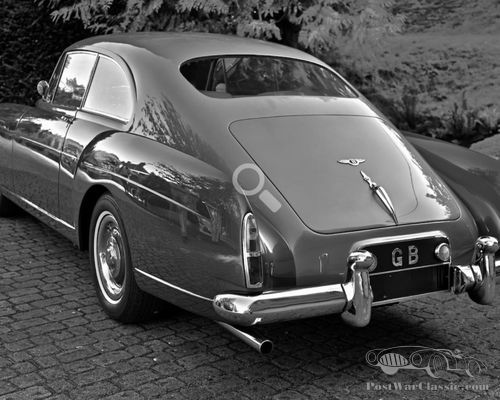
1957 Bentley S1 Fastback di H.J. Mulliner.
1957 Bentley S1 Fastback by H.J. Mulliner.Vettura recentemente restaurata e premiata, in condizioni pari al nuovo. Si tratta di un esemplare..
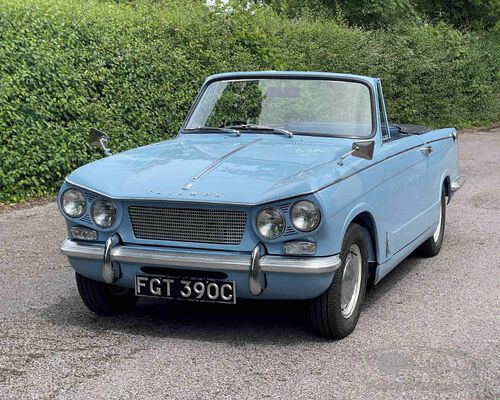
Triumph Vitesse 6 Convertible
Specifiche tecnicheMarca e modello: Triumph Vitesse 6 ConvertibleAnno: 1965Immatricolazione: Regno UnitoNumero d..
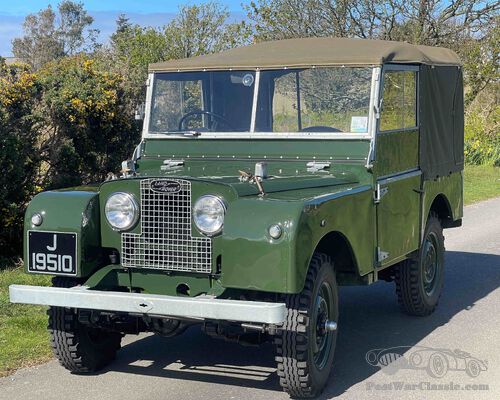
1952 Land Rover Series 1
Specifiche tecniche:Marca e modello: Land Rover Series !Anno: 1952Targa: immatricolata a Jersey..