La rivista e il marketplace globale per gli appassionati di auto d’epoca, creati da appassionati.


Il mercato; tutte le auto prebelliche in vendita
Panoramica degli annunci correlati all'annuncio 1976 Alfa Romeo Sports Coupé by Autotecnica del Lario | RM Sotheby's | The Woodcote Park Auction
-

1969 Mercedes-Benz 280 SL ‘Pagoda’ | Historics Auctioneers | 24th Sept 2022
In 1963, Mercedes-Benz debuted an all-new roadster to replace the 190 SL and 300 SL - the 230 SL. The 230 SL 'Pagoda' was a stunning Paul Bracq designed two-seat convertible that followed Mercedes' new design language, featuring crisp lines and upright headlights. To save on weight, the bonnet, door-skins, boot lid, and tonneau cover were all compo.. -
1968 MG C Roadster to V8 specification | Historics Auctioneers | 24th Sept 2022
The MGC was the first 'high performance' version of the MGB. From early in the design stages of the MGB there was an intention to create high performance variants, using a range of Vee engines that did not make it to production. The MGC was much more than a tuned MGB, in fact it was a completely re-engineered car, but retained many visual connectio.. -
1968 Daimler 250 V8 | Historics Auctioneers | 24th Sept 2022
This example of Daimler’s 1960s line-up utilised the powerful 2.5 litre, V8 engine made famous in the 250SP. This model range, launched in 1962, was effectively a rebadged Mk. II but the engine was a silky-smooth power plant mated to a standard automatic gearbox. In 1967, it was renamed the V8-250 and differed in relatively small details such as sl.. -
1964 Buick Wildcat | Historics Auctioneers | 24th Sept 2022
As automobile designers in the USA moved away from the excesses of the 1950s, the 1960s saw a new maturity in design that produced some of the best-looking cars in the history of the industry. Gone were the excessively chromed, bloated and finned bodies; in their place appeared sleek and low-slung machines that emphasised power, speed, comfort and.. -
1964 MG B Roadster | Historics Auctioneers | 24th Sept 2022
The MGB is a staple of everyday life. After launch in 1962, it went on to become one of Britain’s best-selling and most loved sports cars, bringing stylish design, an exciting drive and everyday usability to thousands of drivers who were glad to switch from sensible saloons. Due to their popularity and reliability, the club support is excellent wit.. -
1965 MG B Roadster | Historics Auctioneers | 24th Sept 2022
The MGB was launched in May 1962 to replace the MGA and was introduced as a four-cylinder roadster with a coupé added in 1965. It was a relatively modern design at the time of its introduction, utilising a monocoque structure instead of the traditional 'body-on-frame' construction used on both the MGA and MG T-types. The lightweight design reduced .. -
1968 Mercedes-Benz 280 SL | Historics Auctioneers | 24th Sept 2022
The Mercedes-Benz 280 SL was introduced in December 1967 and continued in production until February 1971. An all new design by Paul Bracq to replace the 190 SL and 300 SL Roaster. The 280 SL had a powerful 2.8 litre version of Mercedes inline-six and used Bosch fuel injection. To save on weight the bonnet, boot lid and tonneau cover were all compos.. -
1969 Volkswagen Beach Buggy 'Trans-Am' Prowler by East Coast Buggies | Historics Auctioneers | 24th Sept 2022
The Meyers Manx beach buggy was huge in California, produced by engineer & boat builder Bruce F. Meyers from 1964 to 1971. The car dominated dune racing in its time, breaking records immediately and was eventually released in road-oriented models. The Manx gained immense popularity around the globe - Steve McQueen drove one in The Thomas Crown .. -
1968 Aston Martin DBS (Six-cylinder) | Historics Auctioneers | 24th Sept 2022
Following on from the DB6, the DBS was initially conceived as a limited production, fast two-seater and prepared to accommodate the new Tadek Marek-designed V8 engine. The DBS evolved throughout its development cycle to include deeper spoilers and better ventilation. The ‘four-headlight’ DBS has become highly valued and a very early manual car, suc.. -
1960 Porsche Diesel Junior Tractor
- A Beautifully Restored Example Of Porsches Early Agricultural Offering - Powered By An Air-Cooled 14 hp 822 cc Single-Cylinder Diesel EngineSports cars are what eventually brought Ferdinand Porsche into the automotive limelight but they were not his first foray into wheeled vehicles. While working on making a “people’s car” for Volkswag..



In primo piano
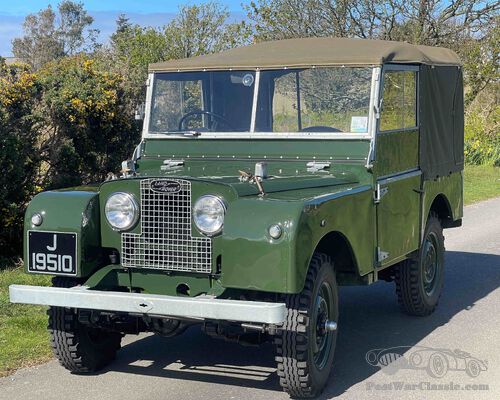
1952 Land Rover Series 1
Specifiche tecniche:Marca e modello: Land Rover Series !Anno: 1952Targa: immatricolata a Jersey..
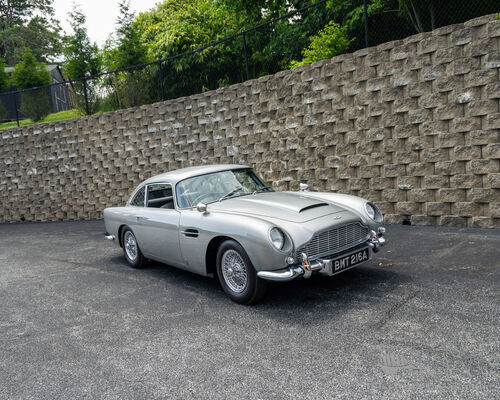
2020 Aston Martin DB5 Goldfinger Continuation | RM Sotheby's | The Monterey Auction
To Be OFFERED AT AUCTION at RM Sothebys' The Monterey Auction event, 13 - 15 August 2026. $1,000,000 - $1,500,000 USD One of 25 examples co..
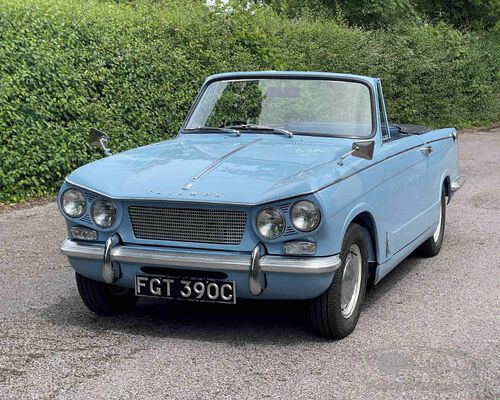
Triumph Vitesse 6 Convertible
Technical SpecificationsMark & Model: Triumph Vitesse 6 ConvertibleYear: 1965Registration plate: UK registered