La rivista e il marketplace globale per gli appassionati di auto d’epoca, creati da appassionati.


Il mercato; tutte le auto prebelliche in vendita
Panoramica degli annunci correlati all'annuncio 1971 Ferrari Dino 246 GT by Scaglietti | RM Sotheby's | The Woodcote Park Auction
-

1972 Morris Mini 850 owned by World Champion Boxer ’Prince' Naseem Hamed | Historics Auctioneers
The history of this revolutionary motorcar is well known and its impact socially, culturally and mechanically is well documented. The Swinging Sixties, The Beatles, Twiggy and the Mini are inexorably combined to represent an era that is remembered with great fondness by many people. The production version of the Mini was demonstrated to the press i.. -
1973 Jensen Interceptor Mk. III | Historics Auctioneers
With the Interceptor’s introduction in 1967, Jensen switched from glass fibre to steel for its car bodies. Underneath, the preceding C-V8’s chassis, running gear and 6,276cc Chrysler engine remained substantially unchanged. With around 280bhp on tap, performance was more than adequate, The Motor magazine recorded a top speed of 140mph with 100mph a.. -
1970 Triumph TR6 | Historics Auctioneers
The Triumph TR6 was manufactured for seven years from 1969 and by the time production came to an end in July 1976, it was the best-seller of the TR range. The bodywork closely resembled that of the previous model, the Triumph TR5, however the front and rear were squared off and all TR6s featured inline six-cylinder engines. For the US market, th.. -
1972 Citroën SM | Historics Auctioneers
In 1961, Citroën began work on 'Project S', a sports variant of the revolutionary Citroën DS. As was customary for the firm, many running concept vehicles were developed, increasingly complex and upmarket from the DS. Citroën purchased Maserati in 1968 with the intention of harnessing Maserati's high-performance V6 engine technology to produce a tr.. -
1971 Jaguar E-Type Series III 2+2 Coupé | Historics Auctioneers
By the mid-1960s, the Jaguar E-Type was appealing to the man with a young family but who were restricted by the size of the current Jaguar E-Type Coupé and its open topped sibling. This prompted Jaguar to offer a third option in the form of a 2+2 Coupé. By adding nine inches to the wheelbase and two inches in height, it was then possible to fit a r.. -
1971 Ford Capri Mk. I 3000E | Historics Auctioneers
Inspired by the success of the Mustang ‘Pony Car’ in the USA, Ford introduced a new model in 1968 for the European market, the Capri, ‘the car you’ve always promised yourself’. The Capri’s imaginative fastback styling was a relatively new departure for Ford, but beneath the lovely body design it remained typically Ford, sharing engines, gearboxes a.. -
1973 Jaguar E-Type Series III Roadster | Historics Auctioneers
By the mid-1960s, the Jaguar E-Type was appealing to the man with a young family but who were restricted by the size of the current Jaguar E-Type coupé and its open topped sibling. This prompted Jaguar to offer a third option in the form of a 2+2 coupé. By adding nine inches to the wheelbase and two inches in height, it was then possible to fit a r.. -
1988 Ferrari Mondial QV GTB (3.2 Litre) | Historics Auctioneers
With a name reminiscent of the 500 Mondial race cars from the 1950s, the Ferrari Mondial was a replacement model for the Ferrari 308 GT4. The Mondial was the first Ferrari where the entire engine, gearbox and rear suspension assembly was mounted on a detachable steel subframe, making engine removal for a major rebuild or cylinder head removal much .. -
1970 Mercedes-Benz 280 SL Pagoda | Historics Auctioneers
The Mercedes-Benz 280 SL was introduced in December 1967 and continued in production till February 1971. The 280 SL had a powerful 2.8 litre inline six-cylinder engine, the bonnet, boot lid, door skins and tonneau cover were made of aluminium to reduce weight. The comparatively short and wide chassis, combined with an excellent suspension, powerful.. -
MG B SPIDER MKIII RUBBER BUMPER 1979
DESCRIZIONE VETTURAMG C spider verde inglese, costruita nel 1968 con targhe bianche. Molto buone condizioni di meccanica, interni. La carrozzeria presenta piccolissimi difetti dovuti dal tempo. Il modello offerto è stato costruito in solamente 4544 esemplari tra gli anni 1967 e '69 nelle versioni spider. Differisce dalla versione B per il..


In primo piano
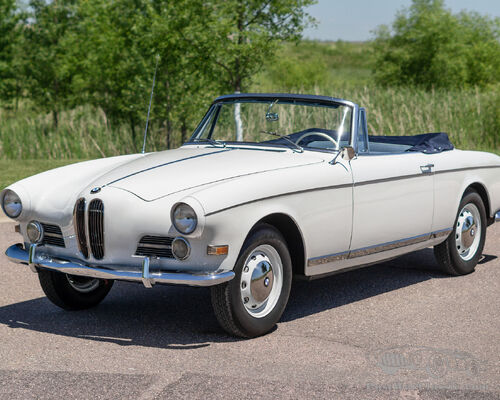
1957 BMW 503 Cabriolet (V8) – 1 di 13 costruiti per il mercato USA – #Esemplare matching
1957 BMW 503 Cabriolet Serie 1V8 in alluminio originale # MatchingCarrozzeria in alluminio originale con stampigliature di fab..