La rivista e il marketplace globale per gli appassionati di auto d’epoca, creati da appassionati.


Il mercato; tutte le auto prebelliche in vendita
Panoramica degli annunci correlati all'annuncio 1976 Ferrari 308 GTB 'Vetroresina' by Scaglietti | RM Sotheby's | The Monterey Auction
-

1973 Jaguar E-Type Series III Roadster | Historics Auctioneers
The E-Type Series III was introduced in 1971, with a new 5.3 litre, V12 engine, uprated brakes and standard power steering. Optionally, an automatic transmission, wire wheels and air conditioning were available. The brand new V12 engine came with four Zenith carburettors and was claimed to produce 272bhp, more torque, and a 0-60mph acceleration of .. -
1974 BMW 2002Tii Cabriolet | Historics Auctioneers
BMW's director of product planning, Helmut Werner Bönsch and Alex von Falkenhausen, the designer of the BMW M10 engine, had both been owners of a 1600-2 (1602) and, subsequently, had both installed a two-litre engine in their respective cars. Following the realisation that they had both made the same modification, they prepared a joint proposal to .. -
1991 Ferrari Testarossa | Historics Auctioneers
Ferrari unveiled the new Testarossa at the 1984 Paris Motor Show marking the end of production of the Boxer, the car that had been the flagship 12-cylinder Ferrari model for the previous ten years. Styled by Pininfarina, the Testarossa paid homage to the great 1950s sports racer that originally bore the name, simply translating as 'Red Head'; the r.. -
1994 Ferrari 348 Spider | Historics Auctioneers
The Ferrari 348 was a mid-engined, rear wheel drive V8 powered two-seater replacing the 328 in 1989 and continuing until 1995. Badged 348 TB for the coupé (Berlinetta) and 348 TS (Spider) for the targa versions, it features a naturally aspirated 3.4 litre version of the quad-cam, four valve per cylinder engine which was originally found in the 288G.. -
1976 Lancia Fulvia 1.3S | Historics Auctioneers
The Lancia Fulvia was introduced at the Geneva Motor Show in 1963 with production running all the way through to 1976. Fulvia’s are notable for their role in motor racing history, including winning the International Rally Championship in 1972. On testing it in 1967, Road and Track summed up the Fulvia as ‘a precision motorcar, an engineering tour d.. -
1979 Jaguar SS100 by Suffolk Engineering | Historics Auctioneers
The SS100 was built between 1936 and 1940 by SS Cars Ltd of Coventry, England. The nomenclature was to reflect the theoretical 100mph maximum speed and once approved by Sir William Lyons, the name 'Jaguar' was given to a new saloon version in 1936. Widely considered to be one of the most aesthetically pleasing Jaguar cars ever built, it is also one.. -
1972 Jensen Interceptor Mk. III | Historics Auctioneers
Launched in 1966, the Jensen Interceptor broke away from the company's traditional method of construction that used glass reinforced plastic with the new car now incorporating an all steel bodyshell. Designed by Carrozzeria Touring, the early cars were built by Vignale before production was eventually carried out at the Jensen works in West Bromwic.. -
1989 Ferrari Testarossa | Historics Auctioneers
At the Paris Salon of 1984, Ferrari presented the successor to the legendary BB512 after nearly ten years of production. Called Testarossa, referring to the legendary Le Mans winning car, it is again the work of Pininfarina. The Testarossa is equipped with a 12-cylinder boxer engine inaugurated in 1972 on the 365 GT4 BB. The capacity is increased t.. -
1977 Alfa Romeo 2000 Spider Veloce | Historics Auctioneers
The Alfa Romeo Spider was produced from 1966 to 1993 and is widely regarded as a design classic. It remained in production for almost three decades with only minor aesthetic and mechanical changes. The first presentation of the car, as a prototype, was at the Turin Motor Show in 1961; however, the continuing success of existing models and the econo.. -
1972 Datsun 240Z | Historics Auctioneers
It soon became apparent during its creation, that the Datsun 240Z represented all the requirements of sports-minded drivers by fulfilling their desires for superb styling, power and safety whilst providing them with the most thrilling and enjoyable ride available in any car at that time. Reporting 151bhp and 146lb/ft of torque at just 4,400rpm, Car..



In primo piano
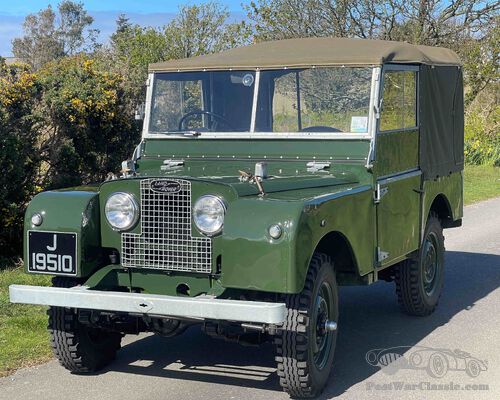
1952 Land Rover Series 1
Specifiche tecniche:Marca e modello: Land Rover Series !Anno: 1952Targa: immatricolata a Jersey..
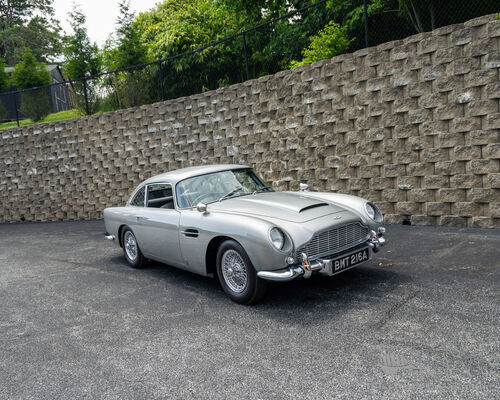
2020 Aston Martin DB5 Goldfinger Continuation
Offerta all'asta da RM Sotheby's durante The Monterey Auction, 13-15 agosto 2026. Stima: 1.000.000-1.500.000 USDUno dei s..
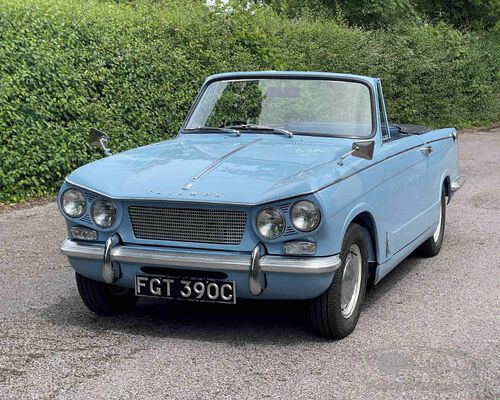
Triumph Vitesse 6 Convertible
Specifiche tecnicheMarca e modello: Triumph Vitesse 6 ConvertibleAnno: 1965Immatricolazione: Regno UnitoNumero d..