La rivista e il marketplace globale per gli appassionati di auto d’epoca, creati da appassionati.


Il mercato; tutte le auto prebelliche in vendita
Panoramica degli annunci correlati all'annuncio 1958 Land Rover Series II 'Art Car' by Sean Wotherspoon | RM Sotheby's | The Woodcote Park Auction
-

1958 Ferrari 250 GT Tour de France Berlinetta | Amelia Island Auctions | Gooding & Co | March 2-3, 2023
In 1956, Ferrari responded to the FIA’s new GT Class championship by creating a dual-purpose, road-racing model based on the 250 GT. With a competitiontuned, three-liter V-12 and lightweight aluminum coachwork by Carrozzeria Scaglietti, the resulting 250 GT Berlinetta was a potent force in sports car racing through the late 1950s. The n.. -
1956 Austin-Healey 100M | Amelia Island Auctions | Gooding & Co | March 2-3, 2023
Following the extraordinary success of the 100/4, Austin-Healey released a high-performance version of the roadster, the 100M, which was equipped with the Le Mans package. This package included larger SU H6 carburetors, a cold air box, high-lift cam, increased compression, stiffer suspension, and a racy louvered hood with leather strap. In all, .. -
1956 Studebaker Golden Hawk | Amelia Island Auctions | Gooding & Co | March 2-3, 2023
Studebaker marketed its new-for-1956 Hawk models as “the family sports car,” a claim made good in the top-of-the-line Golden Hawk series which, for 1956 only, was powered by the robust Packard V-8 engine producing an impressive 275 hp. Coupled with a low curb weight for a five-passenger car, it gave the Golden Hawk bragging rights to the best po.. -
1959 Volkswagen Karmann Ghia Convertible | Amelia Island Auctions | Gooding & Co | March 2-3, 2023
In 1957, Volkswagen announced a cabriolet version of the increasingly popular Karmann Ghia for their 1958 model year. Like its coupe counterpart, these convertibles featured what enthusiasts now refer to as the “low light,” front-end design, which lasted until late 1959. Built in small numbers for only a year and a half, low -light Karmann Ghia .. -
1953 OSCA MT4 2-AD Spider | Amelia Island Auctions | Gooding & Co | March 2-3, 2023
Officine Specializzate Costruzione Automobili, or OSCA, was established in Bologna, Italy, by Bindo, Ernesto, and Ettore Maserati in 1947, when they left the company that bore their name. Over the next two decades, the Maserati brothers built, in extremely limited numbers, an astonishing variety of sports racing, grand touring, and formula cars,.. -
1953 Alfa Romeo 1900C Sprint | Amelia Island Auctions | Gooding & Co | March 2-3, 2023
Presented at the 1950 Paris Motor Show, the Alfa Romeo 1900 was designed by Orazio Satta, a one-time understudy to 1930s Grand Prix engineer Wilfredo Ricart. The marque’s first assembly line-built model, the 1900 utilized unitary construction that specifically allowed coachbuilders to re-body it. Advertised as “the family car that wins races,” t.. -
1955 Mercedes-Benz 300 SL Gullwing | Amelia Island Auctions | Gooding & Co | March 2-3, 2023
Universally recognized as a design and engineering masterpiece, the Mercedes- Benz 300 SL Gullwing Coupe firmly ranks among the finest postwar European sports cars. Based upon the W194 competition coupes which convincingly returned Mercedes-Benz to racing and utterly dominated the 1952 international racing season, the model was refined for produ.. -
1952 Fiat 1400 Rondine Coupe | Amelia Island Auctions | Gooding & Co | March 2-3, 2023
At the 1950 Geneva Motor Show, Fiat revealed its first all-new postwar model – the 1400. Throughout the early 1950s, the 1400 served as a basis for many spectacular custom-bodied cars, designed and built by coachbuilders including Bertone, Pinin Farina, Ghia, Touring, and Vignale. Presented here is a charming coachbuilt Fiat 1400 from t.. -
1956 Studebaker Golden Hawk | Amelia Island Auctions | Gooding & Co | March 2-3, 2023
First to the market with a personal luxury car, Studebaker introduced its Golden Hawk for 1956, inspired by the Raymond Loewy-designed Starlight Coupe three years earlier. Employing Packard’s 275 hp V-8 for 1956 only, the Golden Hawk combined luxury and performance in an elegant presentation. Less than 4,100 were built that year and approximatel.. -
1955 Ford Thunderbird | Amelia Island Auctions | Gooding & Co | March 2-3, 2023
Introduced at the 1954 Detroit Auto Show, Ford Motor Company dubbed its new two-place Thunderbird, a “Personal Car of Distinction.” Unlike Chevrolet’s new Corvette, the Thunderbird catered more to style and comfort than raw sports car performance. The striking Ford convertible was nicely appointed with standard equipment, while myriad available ..



In primo piano
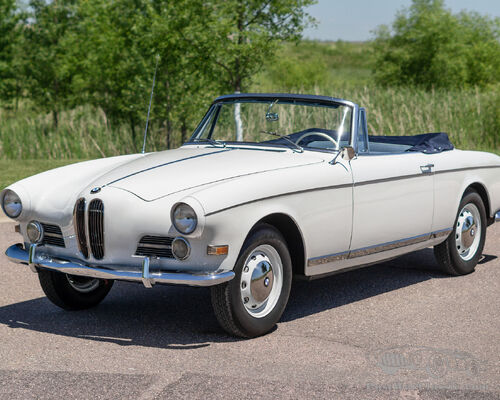
1957 BMW 503 Cabriolet (V8) – 1 di 13 costruiti per il mercato USA – #Esemplare matching
1957 BMW 503 Cabriolet Serie 1V8 in alluminio originale # MatchingCarrozzeria in alluminio originale con stampigliature di fab..