La rivista e il marketplace globale per gli appassionati di auto d’epoca, creati da appassionati.
La rivista e il marketplace globale per gli appassionati di auto d’epoca, creati da appassionati.


Faccia la sua scelta
- Automobile
-
Marca >>
-
Anno >>
-
- Motociclette
-
Anno >>
-
-
Ubicazione >>
- Parti e altro
-
Marca dell'auto >>
-
Produttore >>
-
Categoria >>
-
Paesi


Il mercato; tutte le auto prebelliche in vendita
Panoramica degli annunci correlati all'annuncio 1949 Ford Custom Station Wagon | RM Sotheby's | The Hershey Auction
-

1948 Silverstone-Bodied Healey | Humbert & Ellis Ltd | L'asta termina il 13 luglio 2023
Registrazione: LWA 382Telaio n.: 1677Immatricolato il 30 settembre 1948, il telaio n. 1677 era originariamente una Healey Duncan Saloon su un telaio di tipo B. È stato convertito in un buon standard in un periodo di oltre 25 anni fa per replicare una Healey Silverstone, forse utilizzando un telaio di tipo C per parte della costruzi..1948HealeySilverstoneVENDUTOUbicazione: Regno Unito -
1948 Allard L-Type Tourer | Humbert & Ellis Ltd | Ends July 13, 2023
Registration: DFR 82 Chassis No: 71L/525Registered 1st May 1948, this is an L-Type Tourer which is understood to have been part of this collection since the middle 1970's. Understood to have been restored around 1986/87, it has seen little service since. It was seemingly Cream when new, at some point Gunmetal Grey, and now it is White in ..1948AllardL-Type TourerVENDUTOUbicazione: Regno Unito -
1948 Allard L-Type 4-Seater Tourer | Humbert & Ellis Ltd | Ends July 13, 2023
Registration: JNF 39 Chassis No: 71L/407First registered on 16th July 1948, this four-seater tourer wore then, as it does now, Blue paintwork, and presumably the same style leather interior which is present today. It has a wooden dashboard fascia, a combination of Allard, Smiths and Lucas instruments, a Bluemel's Brooklands wire steering ..1948AllardL-Type 4-Seater TourerVENDUTOUbicazione: Regno Unito -
1948 Allard K-Series Sports | Humbert & Ellis Ltd | Ends July 13, 2023
Registration: JDH 169 Chassis No: 71K/633This striking K-Series two-seat sportscar in Red looks an eyeful and sits 'just right'. The side profile view of this car is perhaps the most pleasing. The paintwork is largely good, as is most of the brightwork. It has wire wheels which were a period option which few people undertook, and the tyre..1948AllardK-Series TourerVENDUTOUbicazione: Regno Unito -
1968 Ford Cortina Mk. II 1600GT Crayford | Windsor View Lakes Sale - July 2023 | Historics Auctioneers
The second incarnation of the Cortina was designed by Roy Haynes and launched on 18th October 1966, four years after the original Cortina. Although the launch was accompanied by the slogan 'New Cortina is more Cortina'. Improvements included a better turning circle, softer suspension, self-adjusting brakes and clutch, together with the availability..1968FordCortina Mk. II 1600GT CrayfordVENDUTO -
1965 Ford Anglia 105E Rally Car | Windsor View Lakes Sale - July 2023 | Historics Auctioneers
When the Anglia 105E was introduced in September 1959, Ford switched to an overhead valve engine for its smallest family saloon. The 997cc four-cylinder unit proved to be a very reliable unit and lent itself to being tuned, hence the success in Formula 3 and Formula Junior. The suspension retained the McPherson strut at the front and live rear axle..1965FordAnglia 105E Rally CarVENDUTO -
1982 Ford Escort Mk. II Group 4 Rally Car | Windsor View Lakes Sale - July 2023 | Historics Auctioneers
The squarer-styled Escort Mk. II appeared in January 1975 with the first production models having rolled off the production lines on 2nd December 1974. Unlike the first Escort (which was developed by Ford of Britain), the second generation was developed jointly between the UK and Ford of Germany. Codenamed ‘Brenda’ during its development, it had th..1982FordEscort Mk. II Group 4 Rally CarVENDUTO -
1966 Ford Lotus Cortina Mk. I | Windsor View Lakes Sale - July 2023 | Historics Auctioneers
There are few road and racing cars more instantly recognised than a Lotus Cortina, with its green arrow pointing its way so clearly towards success. Using Ford's eponymous two-door saloon and Colin Chapman's fabulous twin-cam engine, the marriage was a match made in heaven. Chapman commissioned Harry Mundy, he of Coventry Climax fame, to come up wi..1966FordLotus Cortina Mk. IVENDUTO -
1949 Triumph 2000 Roadster | Windsor View Lakes Sale - July 2023 | Historics Auctioneers
The Triumph Roadster was produced by Britain's Standard Motor Company from 1946 to 1949. It was first available as the Triumph 1800 Roadster from 1946 to 1948 and then as the Triumph 2000 Roadster from 1948 to 1949. Triumph had been purchased by the Standard Motor Company in 1944 and the managing director of Standard, Sir John Black, wanted a sport..1949Triumph2000 RoadsterVENDUTO -
1946 Jaguar Mk. IV | Windsor View Lakes Sale - July 2023 | Historics Auctioneers
The 1945-1948 Jaguar Mk. IV was Jaguar's first car after World War II and was essentially continuations of the 1938-39 models. Very few of these cars were built for the right hand drive markets as steel was being rationed for goods for export. The origin of the name is rather odd since, back in 1948, there had been no Mk. I to IV Jaguars; the Mk. I..1946JaguarMk. IVVENDUTO


In primo piano
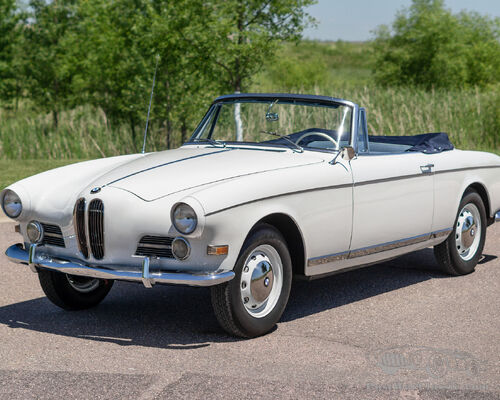
1957 BMW 503 Cabriolet (V8) – 1 di 13 costruiti per il mercato USA – #Esemplare matching
1957 BMW 503 Cabriolet Serie 1V8 in alluminio originale # MatchingCarrozzeria in alluminio originale con stampigliature di fab..
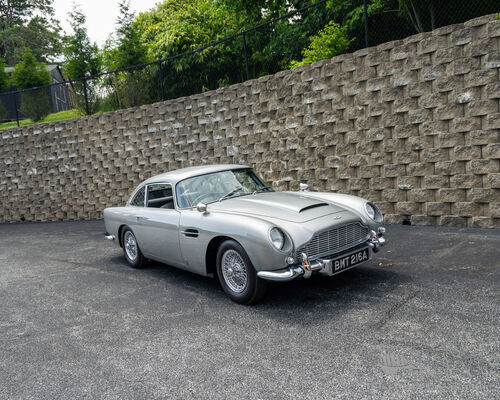
2020 Aston Martin DB5 Goldfinger Continuation | RM Sotheby's | The Monterey Auction
To Be OFFERED AT AUCTION at RM Sothebys' The Monterey Auction event, 13 - 15 August 2026. $1,000,000 - $1,500,000 USD One of 25 examples co..
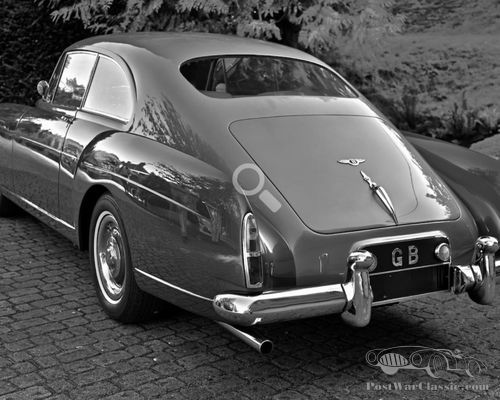
1957 Bentley S1 Fastback by H.J. Mulliner.
1957 Bentley S1 Fastback by H.J. Mulliner.A freshly restored award winning car in like new condition. A later car with Power assited steerin..