La rivista e il marketplace globale per gli appassionati di auto d’epoca, creati da appassionati.
La rivista e il marketplace globale per gli appassionati di auto d’epoca, creati da appassionati.


Filter
Faccia la sua scelta
- Automobile
-
Marca >>
-
Anno >>
-
- Motociclette
-
Anno >>
-
- Parti e altro
-
Marca dell'auto >>
-
Produttore >>
-
Categoria >>
-
Paesi


In praise of the Bond Minicar
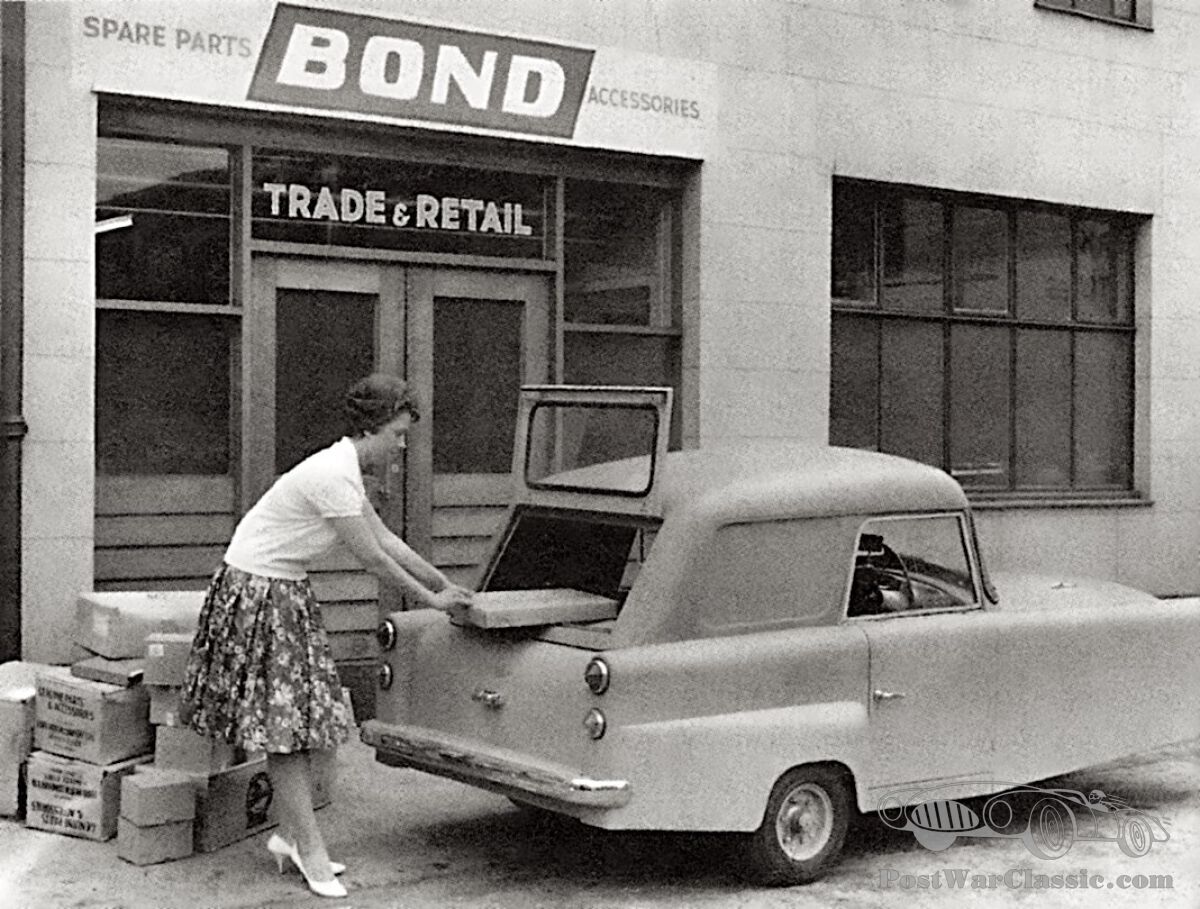

In a time when the world of advertising was not so developed, or exploited perhaps, as it is today, no one thought it strange to see Stirling Moss praising the Bond Minicar as ‘a very likeable little car’. From a period advertorial: “My first surprise came immediately - what a lot of room there is for both driver and passenger, and there is room for a child in between them, though in the Family Model which I borrowed there are two seats at the rear which comfortably accommodate two children!” He goes on about the great pulling power of the 197 cc engine and liveliness being ‘handy in the extreme’, adding cheekily “It is, of course, inadvisable to use too much lock when travelling at fast speed.” Well, you get the point.
We couldn’t quite identify the Minicar seen here, an estate or possibly a commercial model with its closed sides. It’s not in Nick Wotherspoon's superb Bond book, but this photograph simply has to be a public relation shot. You tell us what the car is. The fact is, it’s from another era again. Our lady shopper may be representing the 1950s independent woman in high heels (not exactly handy to drive the Minicar), but perhaps it’s just a little over-the-top. Mind you, in 1958 the Life Peerages Act had only just allowed female peers to sit in the House of Lords. The birth control pill was introduced a year or two later but for married women only. There was a lot to explore many moons before it would be exploited.
Oh, there's no way all those boxes will fit in the little three-wheeler. What’s in them, by the way? Bond spare parts, surely to be needed? Sorry. Making jokes about that would be way too obvious. We love it.
Words Jeroen Booij
Pubblicato:
mercoledì novembre 9th, 2022
Facebook
LinkedIn
Twitter
WhatsApp
Email
Copy
Commenti
brakeservo
13 Novembre 2022, 17:39
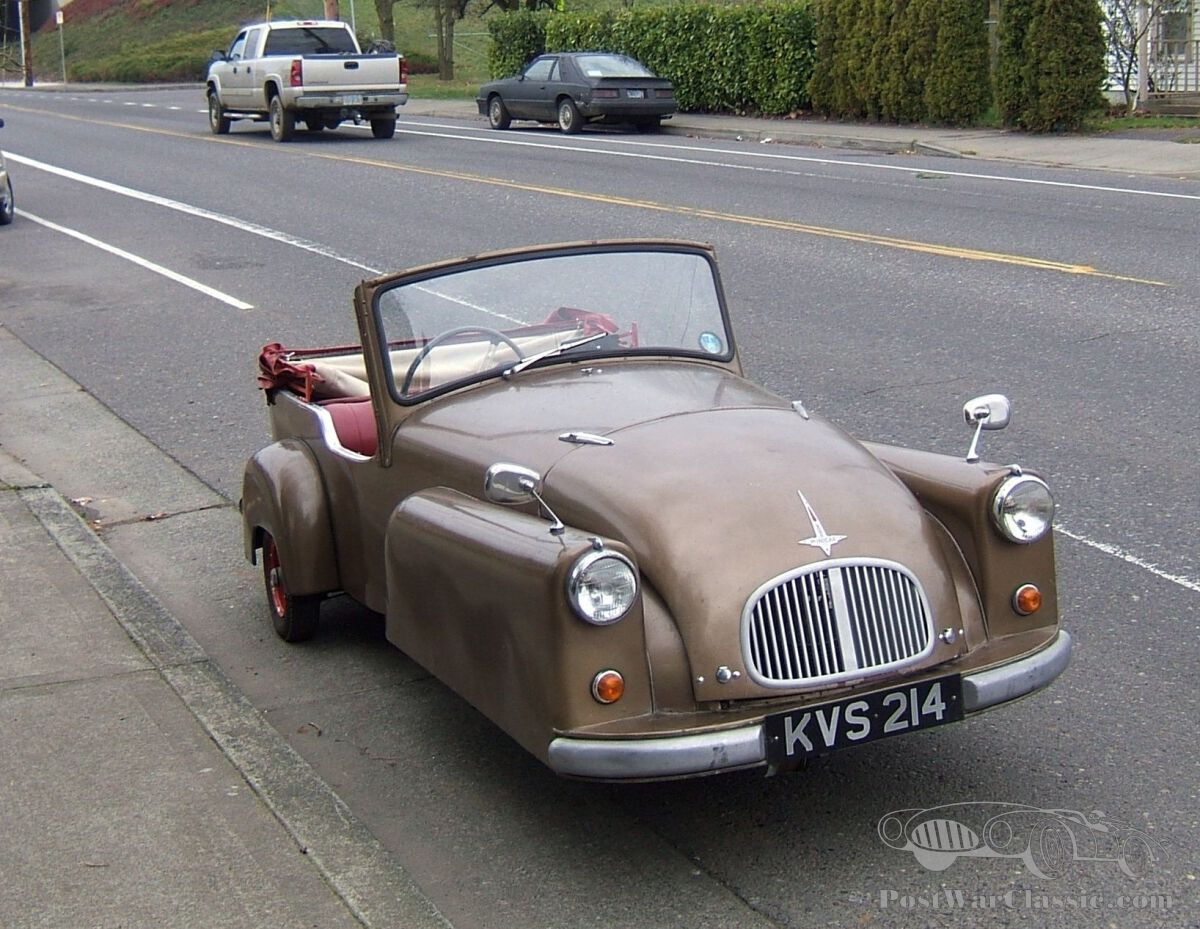
I'm based in USA and have imported two Bond MiniCars, a 1954 Mark C and a 1956 Mark D. With the right mindset, they're a lot of fun, and in the austere post WWII era made a bit of sense, not so much today yet it's too bad we can't return to those simpler times. One memory stands out - driving the Mark C across metropolitan Portland Oregon during afternoon rush hour, surrounded by "soccer moms" in their huge SUVs and overly compensating men with their huge jacked up 4X4s! My biggest fear was stalling the little car as one needed to get out, open the hood and use a kick starter on the little Villiers motorcycle engine that powered it!
Per saperne di più
Philip Joisce
13 Novembre 2022, 11:09
If you look inside the tailgate, the normal rear deck of the saloon is visible. I had a sililarly shaped 1960 Mk F with the 250cc single cylinder engine, the Mk G which followed had a 250 Twin engine.
The hard top unbolted quite easily, so whereas mine had a large rear window, the hardtop in the publicity pic could easily be substituted, turning it into a hatchback.
During the summer I would run around without the top on, from the rear the car looked very low, wide track and sporty with the flared rear arches. The performance was perfectly adequate for a 16 year old legally driving alone with a provisional driving licence. I once saw an indicated 70-75 mph with a very strong following wind and the car was eerily quiet! Normal top indicated speed was 50-55 mph, I slowed down gradually to the normal speed feeling like a test pilot who had just gone through the sound barrier...
You could put it on full lock from standstill and eventually it would go on one rear wheel and the front, I only intentionally did it once and promptly reduced the throttle to get back on all three wheeels. There were a few unintentional two wheel incidents where a corner was tighter than expected on entry, but it handled very well thanks to the wide rear track in relation to the height and centre of gravity.
It was bought for £5, sold for £20 a year and a half later once I had my full 4 wheel licence , It isn't listed by DVLA so I don't think it is around any more - reg was 468 KVK - fond memories!
Per saperne di più
The hard top unbolted quite easily, so whereas mine had a large rear window, the hardtop in the publicity pic could easily be substituted, turning it into a hatchback.
During the summer I would run around without the top on, from the rear the car looked very low, wide track and sporty with the flared rear arches. The performance was perfectly adequate for a 16 year old legally driving alone with a provisional driving licence. I once saw an indicated 70-75 mph with a very strong following wind and the car was eerily quiet! Normal top indicated speed was 50-55 mph, I slowed down gradually to the normal speed feeling like a test pilot who had just gone through the sound barrier...
You could put it on full lock from standstill and eventually it would go on one rear wheel and the front, I only intentionally did it once and promptly reduced the throttle to get back on all three wheeels. There were a few unintentional two wheel incidents where a corner was tighter than expected on entry, but it handled very well thanks to the wide rear track in relation to the height and centre of gravity.
It was bought for £5, sold for £20 a year and a half later once I had my full 4 wheel licence , It isn't listed by DVLA so I don't think it is around any more - reg was 468 KVK - fond memories!
Joop Terpstra
11 Novembre 2022, 16:44
Maybe James Bond transports his shaken not stirred drinks in it? Rather cosy with the Bond Girl next to him on a slow trip to a picknick perhaps? Who knows...
Per saperne di più
The Ranger vehicle in the picture is a standard model painted only in grey primer, lacking any side trims and costing £295 0s 0d. The idea was that the tradesman purchasing such a vehicle could then paint it in his own colours. it appears it was not a popular idea as only 9 vehicles are recorded as being sold in primer only. Most customers appeared to prefer paying the £4 10s 0d extra to have their vehicle painted by the factory in one of the standard colours of the time. This would have been British racing green, light green or scarlet. Hardtops were painted either in stone or white.