La rivista e il marketplace globale per gli appassionati di auto d’epoca, creati da appassionati.
La rivista e il marketplace globale per gli appassionati di auto d’epoca, creati da appassionati.


Filter
Faccia la sua scelta
- Automobile
-
Marca >>
-
Anno >>
-
- Motociclette
-
Anno >>
-
- Parti e altro
-
Marca dell'auto >>
-
Produttore >>
-
Categoria >>
-
Paesi


On The Path of Gods - The Story of the Gutbrod Atlas



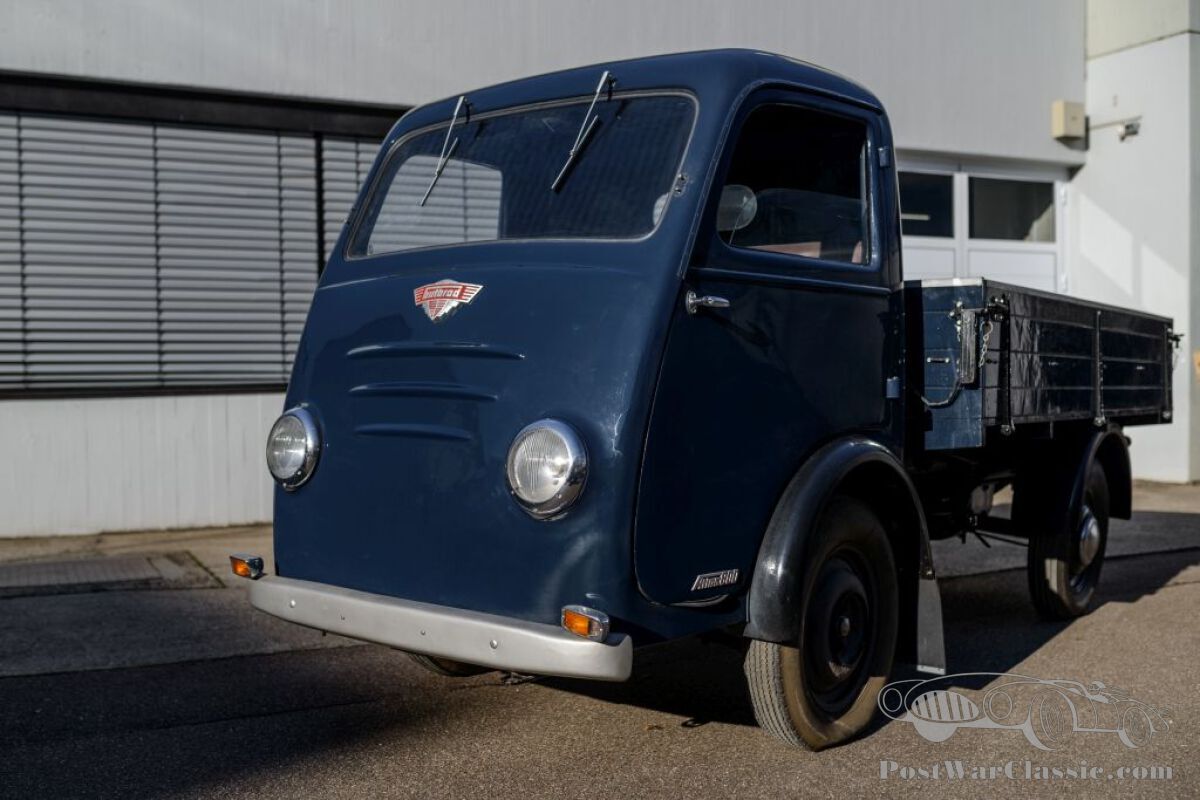
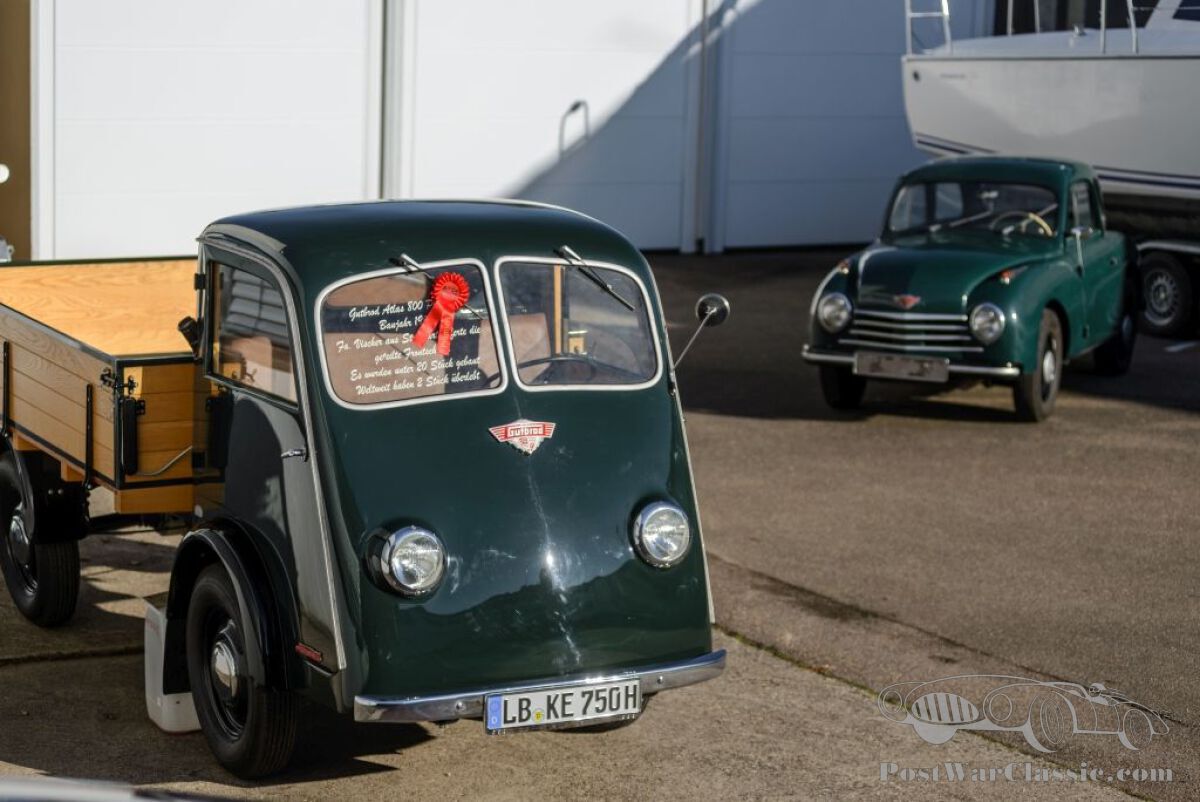


Gutbrod is a largely forgotten German car brand, though its Superior was the first car in serial production with a direct-fuel-injection engine. Rare & Unique Vehicles magazine together with Sammlung K recently published a German-language book on the history of the brand.
Here is a little summary of the Gutbrod Atlas, the company's list line of commercial vehicles which were produced between 1950 and 1953.
Gutbrod Atlas
The story of Gutbrod commercial vehicles goes back to the early 1930s.Wilhelm Gutbrod (1890–1948)was always interested in mechanical things, and though he studied to become an engineer, the First World War put an end to such plans. In 1926 he set up his own company, Standard Fahrzeug fabrik GmbH in Ludwigsburg, where he produced motorcycles. In 1932 he bought a license from Josef Ganz and subsequently launched production of the Standard Superior small car (see Rare & Unique Vehicles No. 2). At the same time the company introduced a three-wheeler goods carrier, the Progress 200. Eventually four-wheeled small Superior-based trucks followed, the bigger Merkur and its smaller companion, named the Hermes.
By the second half of the 1930s, the range was standardized as the P 203, P 503, H 204, H 504, and HV 504 – denominating the number of wheels, engine sizes, and loading capacities. With the outbreak of the Second World War, the authorities only allowed the production of one standardized three-wheeler freight truck by various companies in Germany. Vidal & Sohn’s Tempo A400 was the template – and Standard was ordered to follow it; thus the E1 three-wheeler was born. Though Wilhem Gutbrod considered the Tempo to be inferior, he knew better than to argue with Nazi Party officials. The E1 remained in production until the end of 1941, when Vidal & Sohn intervened.
After the war, Gutbrod first resumed production of agricultural machinery. In the second half of 1945, company managers contemplated using their existing stock of parts for the H-series as a basis that would enable them to put together a series of small trucks.
However, there were two major problems: the pre-war engine supplier disappeared, and the American authorities were reluctant to issue a manufacturing license for such products.
Wilhelm Gutbrod solved the first problem by employing Will Krauter, who previously worked at the Institute for Motor Vehicles in Stuttgart. During the war he designed an air-cooled four-cylinder, two-stroke engine, which was intended as an auxiliary drive for military gliders but probably was never used for that purpose.
Gutbrod’s efforts to convince the Americans to change their minds were fruitless at first. But he persevered, arguingthat the planned delivery van was actually not an automobile but merely a simple means of transport, which was a basic necessity for the population. Besides, he said, the 500cc, 12-14-hpengine was more like a toy thana serious power source, so any chance of using it for a military vehicle was quickly dispelled. Thus Motorenwerk Wilhelm Gutbrod was the first company to receive a production license for small delivery vans in the American zone.
Fora while sales were okay, but it was apparent that the Heck 504 was way past its sell-by date. In 1948, Vidal& Sohns old 3,769 units of its Tempo, followed by Gutbrod with 759 units and Mercedes with 616 units.
Walter Gutbrod, the eldest son of Wilhelm, joined the company in 1945.Following the untimely death of his father in August 1948, he took the helm of the Gutbrod companies – there were two at this time. Previously he had argued with his father about the direction the company was taking as he wanted to focus more on agricultural machinery.
As the head of Gutbrod, Walter decided to plow ahead with development of a new small commercial vehicle. Krauter left the company and engine development work was farmed out to Dr. Ing Schnürle, a two-stroke expert who set up his own engineering company in Stuttgart after the war. It was Schnürle who employed Dr. Hans Scherenberg, a former Daimler-Benz test engineer, while he was waiting for his denazification process to end. Scherenberg became the linchpin of Gutbrod’s engine development program. It was his work that led to the fuel injection engine in the Superior small car. Dr.Schnürle’s engineering office also developed a small air-cooled two-cylinder, two-stroke engine for a new range of small commercial vehicles.
By1949, the platform of the new small van was completed. Its cab was designed by Karl Hannemann, the former head of the body building division at Auto UnionAG. Hannemann worked with a lesser-known Stuttgart-based coachbuilder, Vischer, on the prototypes.
At this time Walter Gutbrod looked at the possibility of bringing cab production in-house but then decided to use a trusted partner, Binz, instead.
By the end of 1949 the new model, code-named “Heck04,”was production ready. All it needed was a catchy name. Continuing the Greek-Roman mythology theme, the name Atlas was chosen. Apparently Goliath and Hansa-Lloyd, both members of the Borgward Group, already offered an Atlas in the 1930s, but in post-war times the name was free to be used.
Production of the Gutbrod Atlas 800 (the name indicating its payload in kg)commenced in 1950, first at Plochingen, then at a new facility in Calw. By the end of the year, Gutbrod offered a full range of bodies from a simple Fahrgestellmit Fahrerhaus(cab-on-chassis)to an eight-seater Omnibus, with prices ranging from DM 4850 to DM 6950.
While Gutbrod achieved a new production record of 4,360 units, competition heated up. Volkswagen sold 5,765 units of its new Transporter, and market leader Tempo had sales of 8820 tricycles. Other well-established players also surpassed Gutbrod: Goliath sold 8,468 three-wheelers, while sales of the DKW Schnellaster amounted to 5,434 units.
Pricing became a key issue with increasing raw-material prices. The Atlas 800 became more expensive and more obsolete as its two-stroke engine was no match for Volkswagen’s four-cylinder, four-stroke unit. A new, higher-payload variant called the Atlas 1000 was unveiled in 1951. In the same year, assembly of the Gutbrod commercial vehicles also commenced in South Africa. By the end of 1952, the financial situation at Gutbrod became dire. Sales of the Atlas dwindled. Payment from the company’s partner in South Africa came irregularly. In the fall of 1953, Gutbrod went into receivership. Altogether, around 11,000 Atlas models were produced in Germany and from1000 to 1300vans were made in South Africa.
Alles Mit Motor - Die Standard Gutbrod Story
This272-page, German language, hard-cover book charts the story of Walter Gutbrod and his company from 1926to 1954. Paul Schilperoord, a Dutch journalist who's done a lot to promote the life and works of Josef Ganz, noted motorcycle historian Andy Schwietzer and brand/expert Otfried Jaus put together a very comprehensive overview, which is accompanied by a photo gallery of surviving vehicles.
More details are on https://gutbrodshop.rareandunique.media/
Pubblicato:
mercoledì luglio 26th, 2023
Facebook
LinkedIn
Twitter
WhatsApp
Email
Copy
Commenti
Danie Snyman
26 Luglio 2023, 09:08
At the time I was about six years old .
I can remember doing a conversion as he could not get parts.
He put a Volkswagen engine in the van.
Were the Gutbrods built in South Africa?